

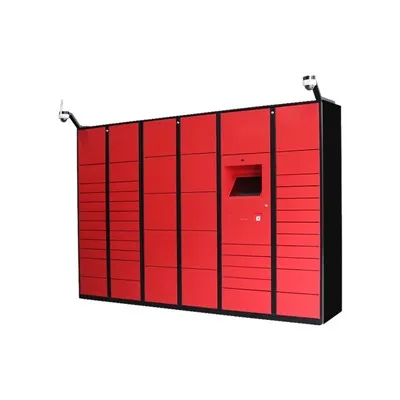


Previously, the process of ordering online and picking up goods in-store typically involved this: arriving at the store, finding a clerk, providing the order number, waiting for the clerk to retrieve the item from the back office, and then verifying the information. This was manageable when there were few customers, but on weekends, holidays, or during major sales events, this simple task easily turned into queuing and waiting.
This is why many retail brands and shopping malls have started paying attention to Pick-Up Lockers in recent years.
While it appears to be just a locker, it actually solves a more practical problem: how can stores more efficiently and reliably handle order pickup and delivery as online orders increase?
The solution provided by in-store pickup lockers is not "delivery of goods," but rather "reducing waiting time."
Many people, upon seeing self-service lockers, might immediately think they're just parcel lockers. However, in retail stores, their function is far more complex.
Store self-service lockers are typically integrated with the order system, store inventory preparation, pickup notifications, locker allocation, and pickup records.
After a user places an order online, the store prepares the goods and places them in the corresponding locker. The system then sends the user a pickup code or notification. Upon arriving at the store, the user scans the code, enters the code, or swipes their receipt to directly open the locker and retrieve their item.
Throughout the entire process, users don't need to constantly approach store staff, and staff don't need to repeatedly handle simple pickup handovers.
Therefore, what self-service lockers truly improve is the store's fulfillment efficiency and the user's certainty in picking up their goods.
Why are new retail stores increasingly in need of this type of equipment?
Because consumer habits have changed.
In the past, people were accepting of "waiting a bit after arriving in the store." Now it's different. After ordering online, users expect a clear, traceable process with minimal waiting time.
Users are primarily concerned with a few questions:
Is the item ready?
When can I pick it up?
Do I still need to queue after arriving in the store?
Will there be no one to handle things when the staff is busy?
Traditional manual pickup processes are easily affected by the situation on-site. How busy the staff is, whether the back office has pre-stocked the items, and how long the queue is all affect the experience.
Self-service pickup lockers standardize this process: order placed in the locker, user picks up, status recorded-the whole process is much clearer.
What should shopping malls and chain brands focus on when deploying self-pickup lockers?
Looking only at the cabinet's appearance and the number of compartments can easily underestimate the project's complexity.
The real issues to assess are:
System integration: Online orders, in-store inventory, and pickup status must form a closed loop;
User pickup ease: Minimal steps, waiting time, and need to ask for directions upon arrival;
On-site location: Mall layout, store entrance, and service counter location all impact the experience;
Anomaly handling: Cases such as overdue pickups, order cancellations, and compartment occupancy must be planned in advance;
Replicability across multiple stores: Successful implementation in one store is not difficult, but stable replication across a chain is challenging;
Ongoing maintenance: Equipment stability and response efficiency directly affect the user experience.
Will self-service lockers become a standard feature for mainstream brands?
I believe the probability is very high.The reason is simple: online ordering and in-store pickup are becoming increasingly common. Once users get used to "receiving a notification and picking up their order at the store," they will find it difficult to accept the inefficiency of manual waiting.
For brands, self-service lockers also offer several practical benefits:
Reducing queues during peak hours;
Reducing the pressure on in-store staff for handover;
Reducing the chances of misplacing items, taking the wrong items, or missing items during handover;
Improving the fulfillment efficiency of online orders to offline stores;
Upgrading stores from sales terminals to service nodes.
Especially in shopping malls, chain retailers, sporting goods, home furnishings, supermarkets, and convenience stores, as long as online orders continue to grow, self-service lockers will become increasingly common.
The deployment of self-pickup lockers in new retail malls is not because lockers are particularly novel, but because the way stores provide services is changing.