

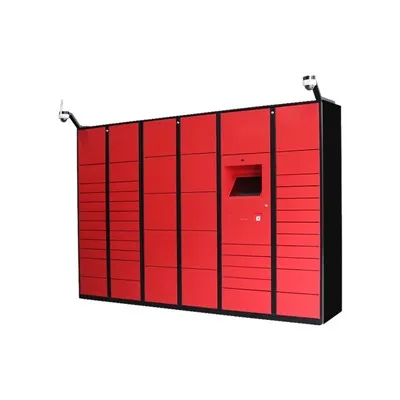


The core function is to maintain order and security in the storage of items in public areas, while also considering durability, space utilization, and harmony with the environment. The locker body uses a split structure, consisting of two independent compartments stacked vertically. Each layer can hold 12 storage units, totaling 24 independent compartments. The size of each compartment should be adjusted according to the items being stored. For example, the height of the slots in a shoe locker is generally not less than 300mm to accommodate different types of shoes.
Material and Process Analysis
The main material of the locker body is usually cold-rolled steel, with a thickness of 0.6-1.0mm, shaped through CNC punching and bending to ensure structural strength. The surface treatment uses a baking finish process, where the paint layer is baked at high temperatures to bond closely with the metal substrate, enhancing corrosion resistance and aesthetics. The advantage of the baking finish is that the paint layer is uniform, has rich color, and is not easily chipped by minor bumps, making it suitable for high-frequency use. In addition, the edges of the locker doors are typically equipped with rubber bump strips to reduce noise during opening and closing and protect the paint surface.
Key Points for Customized Design
Employee lockers support multi-dimensional customization, including color, number of layers, and functional modules. For color, you can choose solid colors or wood grain transfer prints based on the environmental style, with minimalist styles commonly using gray, white, and dark blue as the main tones. Layer customization should consider both the height of the space and user needs. For example, double-layer lockers are suitable for users under 1.8 meters tall, while single-layer taller designs may be chosen for storing larger items such as safety helmets. Functional modules for customization include the addition of ventilation holes, electronic locks, and number plates. Ventilation holes prevent odors from accumulating, while electronic locks enhance security, making them suitable for storing valuables.
How To Choose Employee Lockers
Jan 11, 2026
Leave a message